
How to Use Binance Cloud: A Complete Guide to the White-Label Cryptocurrency Exchange Platform

Binance Cloud is not a traditional cryptocurrency exchange in the sense that retail traders log in to buy and sell coins. Instead, it is a white-label exchange infrastructure service provided by Binance. This platform allows businesses, entrepreneurs, and organizations to launch their own branded cryptocurrency exchange without building the technology from scratch. In simple terms, if you want to start your own exchange similar to Binance, Binance Cloud provides the liquidity, matching engine, security systems, and management tools needed to do so.
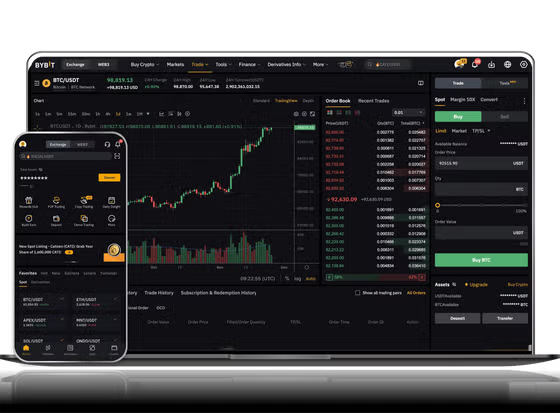
One of the most common misconceptions is that Binance Cloud is a separate trading venue like Binance.com or Binance.US. In reality, it is a backend solution. The exchanges built on Binance Cloud often have their own names, logos, and domain names, but they leverage Binance’s deep order books, wallet infrastructure, and compliance frameworks. For end users, trading on a Binance Cloud-powered exchange feels very similar to trading on Binance itself, including the familiar interface, trading pairs, and fee structures.
To use Binance Cloud, you typically start as an operator. First, you need to apply through the official Binance Cloud website. The application process involves business verification and a discussion of your target market. Once approved, you can customize your exchange’s branding, including the logo, color scheme, and domain name. Binance will then provide you with access to a control panel where you can manage users, spot and margin trading parameters, withdrawal limits, and risk controls. The setup process can be completed in a matter of weeks, which is significantly faster than developing a proprietary trading engine.
From a trader’s perspective, using an exchange built on Binance Cloud is straightforward. You register an account on that specific exchange’s website, complete KYC verification, and deposit funds just like on any standard platform. The trading interface will show the same order types—limit, market, stop-limit—and the same deep liquidity because all orders are routed through Binance’s matching engine. This means that even if the exchange has a small user base, you still benefit from Binance’s global liquidity pool. Withdrawals and deposits are processed through the cloud platform’s wallet system, which is managed by Binance’s security protocols.
Binance Cloud also supports various business models. Some operators use it to create a regional exchange focused on local currencies and regulations. Others use it to build a derivatives exchange for futures and options trading. The platform includes built-in risk management tools, such as auto-deleveraging and insurance funds, which are essential for margin trading. Additionally, it offers fiat gateway integrations, allowing users to buy crypto directly with bank transfers or credit cards in supported regions.
Security is another critical aspect of Binance Cloud. Since the infrastructure is managed by Binance, the cloud exchange inherits Binance’s security layers, including multi-tier and multi-cluster system architecture, cold wallet storage, and real-time monitoring. However, the operator is still responsible for ensuring compliance with local laws, including AML and KYC requirements. For users, this means that while the technology is robust, the regulatory protection depends on the specific exchange operator’s jurisdiction and licensing.
In summary, Binance Cloud is best understood as a turnkey solution for launching a cryptocurrency exchange. For businesses, it is a fast and reliable way to enter the market. For traders, it offers access to Binance’s core trading technology through a branded interface. Whether you are an entrepreneur looking to start your own exchange or a trader curious about the underlying technology, Binance Cloud represents a significant shift in how digital asset exchanges are built and operated.


发表评论